
Home healthcare is professional medical and supportive care delivered at a patient's residence rather than in a hospital or clinic. It can mean a nurse who comes in to dress a surgical wound, a physiotherapist helping someone walk again after a fracture, a trained attendant who supports an elderly parent through the day, or critical-care equipment set up in a bedroom.
For most families, the question arrives at a specific moment: the day a doctor says a patient is ready to go home but not yet ready to manage alone. This guide explains how home healthcare services work, what they can and cannot do, who benefits from them, and how to work out what kind of support a patient actually needs.
What Is Home Healthcare?
Home healthcare is a planned arrangement of healthcare and support services that a patient receives at home, organised around their condition and their treating doctor's advice. It is not a single service but a set of options that can be combined, increased or reduced as the patient's needs change.
The idea is well established in public health. India's National Programme for the Health Care of the Elderly includes home-based care and domiciliary visits by trained health workers among the services older people may need. The World Health Organization describes long-term care as a combination of health services, such as rehabilitation and the management of chronic conditions, with everyday caregiving and social support.
Private providers such as Ayushya Healthcare Services bring this kind of care to homes in Mumbai and Pune, with nurses, attendants, doctors and physiotherapists working from a care plan agreed with the family.
How Does Home Healthcare Work?
Home healthcare usually works in four stages: assessing the patient's needs, agreeing a care plan, delivering care at home, and reviewing that plan as the patient's condition changes.
- Assessment. The family shares the patient's condition, discharge summary and prescriptions with the provider. For complex needs, such as critical care at home, a clinical assessment comes first.
- Care plan. The provider and family agree which services are needed, who will deliver them, the shift pattern and how long care is likely to continue.
- Care at home. Professionals visit or stay as planned, and any equipment, such as a hospital bed or oxygen concentrator, is delivered and set up.
- Review. As the patient recovers or their needs grow, the plan is adjusted with the treating doctor's input.
At Ayushya, the process starts with a conversation with a care advisor, and families receive regular updates once care is under way.
What Types of Healthcare Services Can Patients Receive at Home?
Patients can receive most non-emergency healthcare services at home. These fall broadly into clinical care, daily living support, rehabilitation and medical equipment.
- Clinical care: home nursing care for wound dressing, catheter care and monitoring, prescribed injections, doctor visits at home and, for critically ill patients whose vitals are stable, an ICU setup at home.
- Daily living support: trained attendants who help with bathing, feeding, hygiene and mobility through patient care services, and elderly care for seniors who need steady day-to-day support.
- Rehabilitation: physiotherapy at home after surgery, a stroke or a fracture.
- Equipment: hospital beds, oxygen concentrators, oxygen cylinders and BiPAP machines through medical equipment rental.
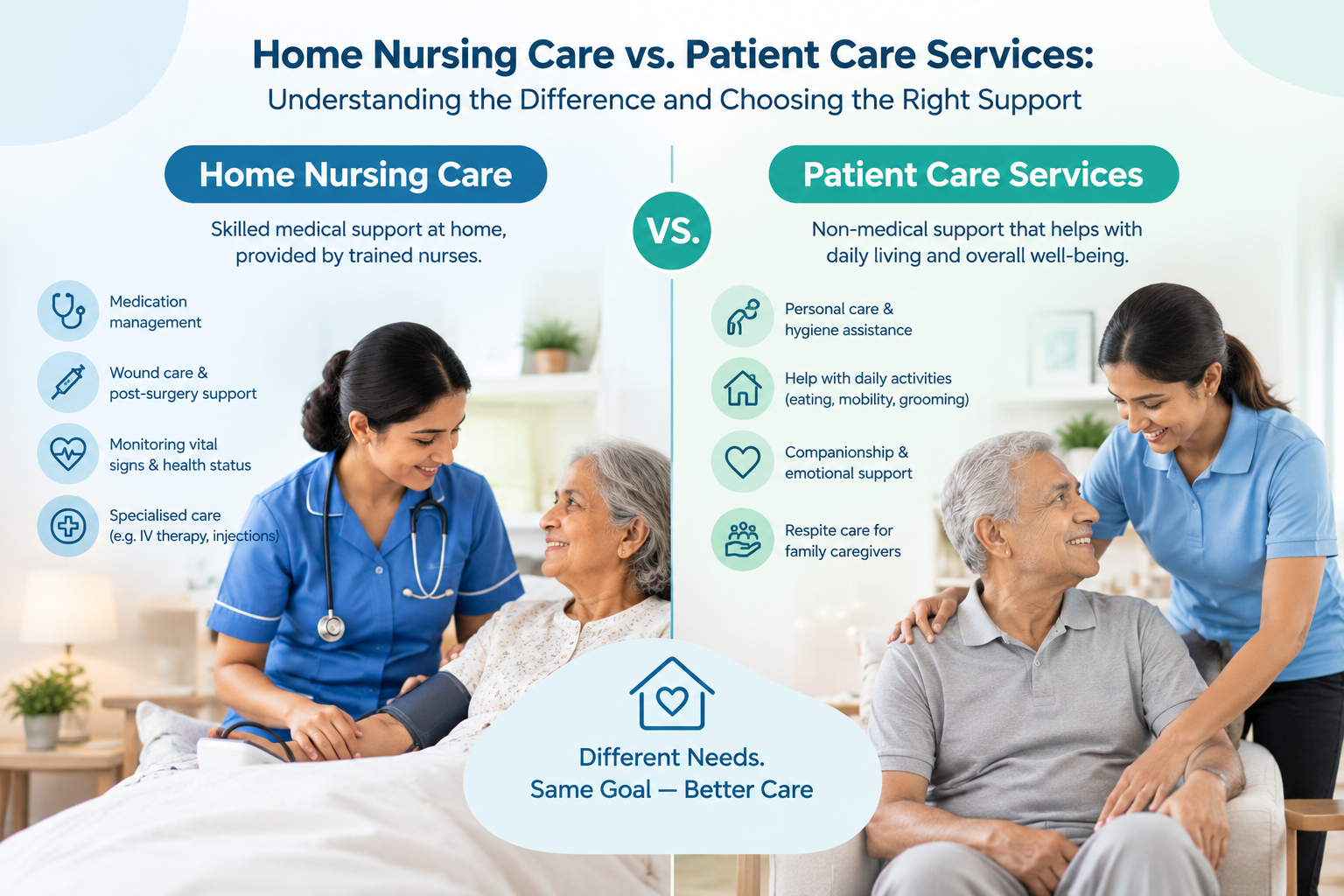
Two of these services are often confused: nursing care and patient care. They involve different people with different training, and the difference matters when you plan care. Our guide to home nursing care vs. patient care services explains where one ends and the other begins.
Explore Home Healthcare Services
Who May Benefit From Home Healthcare?
Home healthcare may benefit patients who need ongoing care but whose condition is stable enough to be managed outside a hospital. That often includes:
- patients recovering after surgery or a hospital stay;
- older adults with limited mobility or long-term conditions such as diabetes, hypertension or heart disease;
- people regaining strength after a stroke, fracture or long illness;
- bedridden patients who need help with daily activities and skin care;
- patients on a schedule of injections, dressings or regular monitoring;
- elderly parents living alone while their children work in another city or abroad.
It also helps family caregivers, who are often trying to balance a patient's needs with work, children and their own health.
When Should Families Consider Professional Healthcare Support?
Families should consider professional support when a patient's needs go beyond what relatives can safely or consistently manage. A few signs tend to make the decision clear:
- the discharge summary lists tasks the family is not trained to do, such as injections, wound care or catheter care;
- the patient has fallen, or is struggling to walk, bathe or use the toilet alone;
- medicines are being missed or mixed up;
- the main family caregiver is exhausted or cannot be home during the day;
- the patient's condition needs regular checks between doctor visits.
Home healthcare is not meant for emergencies. Chest pain, severe breathlessness, sudden weakness on one side of the body, new confusion, heavy bleeding or loss of consciousness need emergency treatment. In India, call 112 or 108 for an ambulance and go to the nearest hospital.
What Are the Benefits and Limitations of Care at Home?
The main benefit of home healthcare is that patients receive care in familiar surroundings without repeated hospital trips. Its main limitation is that it cannot replace hospital treatment for emergencies or for patients whose condition is unstable.
| Benefits | Limitations |
|---|---|
| Familiar surroundings, which many patients find more comfortable | Not suitable for emergencies or patients whose condition is unstable |
| Fewer trips to clinics for injections, dressings or therapy | Some tests and procedures still need a hospital or laboratory |
| One-to-one attention from a nurse or attendant | The home may need changes, such as space for a hospital bed |
| The family stays involved and informed | Families still need to coordinate care and stay in touch with the doctor |
| Care can be scaled up or down as needs change | Round-the-clock care over many months can be a significant ongoing cost |
Whether the benefits outweigh the limits depends on the patient's condition, and that judgement is best made with the treating doctor.
How Can Families Identify the Type of Support a Patient Needs?
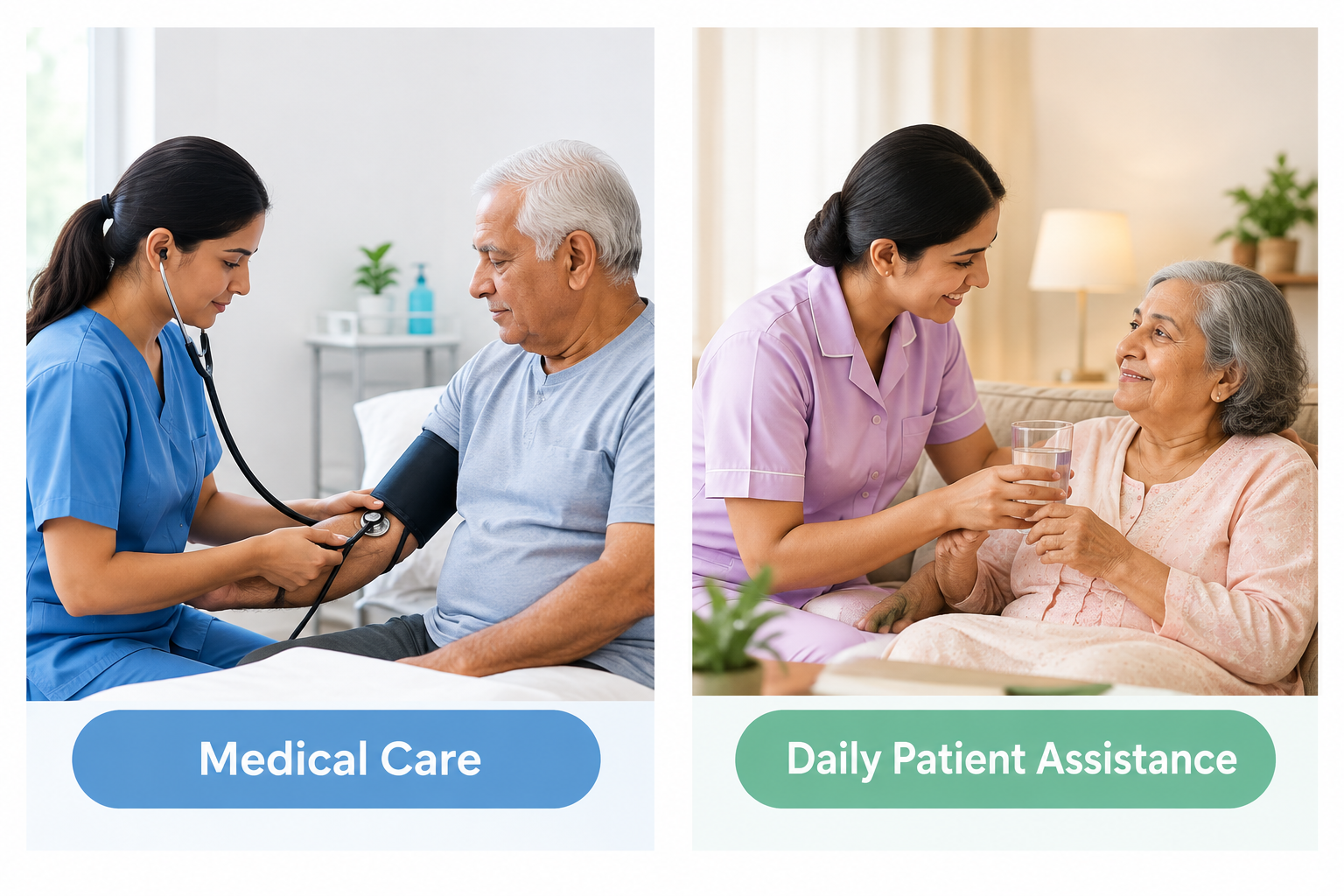
Start by separating the patient's medical needs from their daily living needs. Medical needs are linked to treating or monitoring a condition, such as injections, wound care, physiotherapy or oxygen therapy. Daily living needs concern bathing, eating, dressing, moving around and company.
A practical way to begin is to list everything the patient needs help with over a full day and ask one question of each item: does this need clinical training or a prescription? If it does, it calls for a qualified professional. If it does not, a trained attendant or a family member may be able to help. Our article on the difference between medical care and daily patient assistance at home works through this with examples.
Most patients need a mix. Someone recovering from a stroke, for instance, may need a nurse for medicines and monitoring, a physiotherapist for rehabilitation and an attendant for daily routines. Share the list with the treating doctor before you settle on a plan.
What Should Families Consider When Choosing a Home Healthcare Provider?
Choose a provider that can match the right professional to each need, show the qualifications of its staff and explain its costs and replacement policy clearly. Questions worth asking include:
- Are the nurses qualified and registered? In India, nursing training follows standards set by the Indian Nursing Council, and qualified nurses enrol on a State nursing register.
- Will the care plan follow the treating doctor's instructions, and how will changes be communicated?
- What happens if a caregiver falls ill or cannot come?
- Which services are available in your city, and how soon can care begin?
- What does the quoted cost include, and how is it worked out?
Ayushya Healthcare Services, for example, offers its full range of home healthcare services in both Mumbai and Pune, with nursing and patient care also reaching Thane and Navi Mumbai. The company states that care is typically arranged within 2 to 4 hours of booking confirmation and that its nursing team is qualified at ANM, GNM or B.Sc Nursing level. Its About Us page introduces the team behind the service.
Contact Ayushya Healthcare Services
Frequently Asked Questions
Is home healthcare safe for elderly patients?
Yes, for patients whose condition is stable, provided care is planned with their doctor and delivered by trained professionals. It is not suitable for emergencies or for patients whose condition is changing quickly.
Can home healthcare replace hospital treatment?
No. Home healthcare supports recovery and long-term care outside hospital, but emergencies, surgery and intensive treatment for unstable patients need a hospital.
Do I need a doctor's prescription for home healthcare?
Not for every service. Help with bathing or feeding does not need one, but injections, oxygen therapy, many nursing procedures and physiotherapy should follow a doctor's prescription or advice.
How quickly can home healthcare start?
It depends on the provider and the care needed. Ayushya states that care is typically arranged within 2 to 4 hours of booking confirmation in Mumbai and Pune, while complex setups such as a home ICU need a clinical assessment first.
Are home healthcare services available in Mumbai and Pune?
Yes. Ayushya Healthcare Services provides its home healthcare services in both Mumbai and Pune, including nursing, patient care, elderly care, doctor visits, physiotherapy and medical equipment rental.
Can family members stay involved once professional care starts?
Yes. Families usually help shape the care plan, receive regular updates and continue to support the patient alongside the caregiver.