
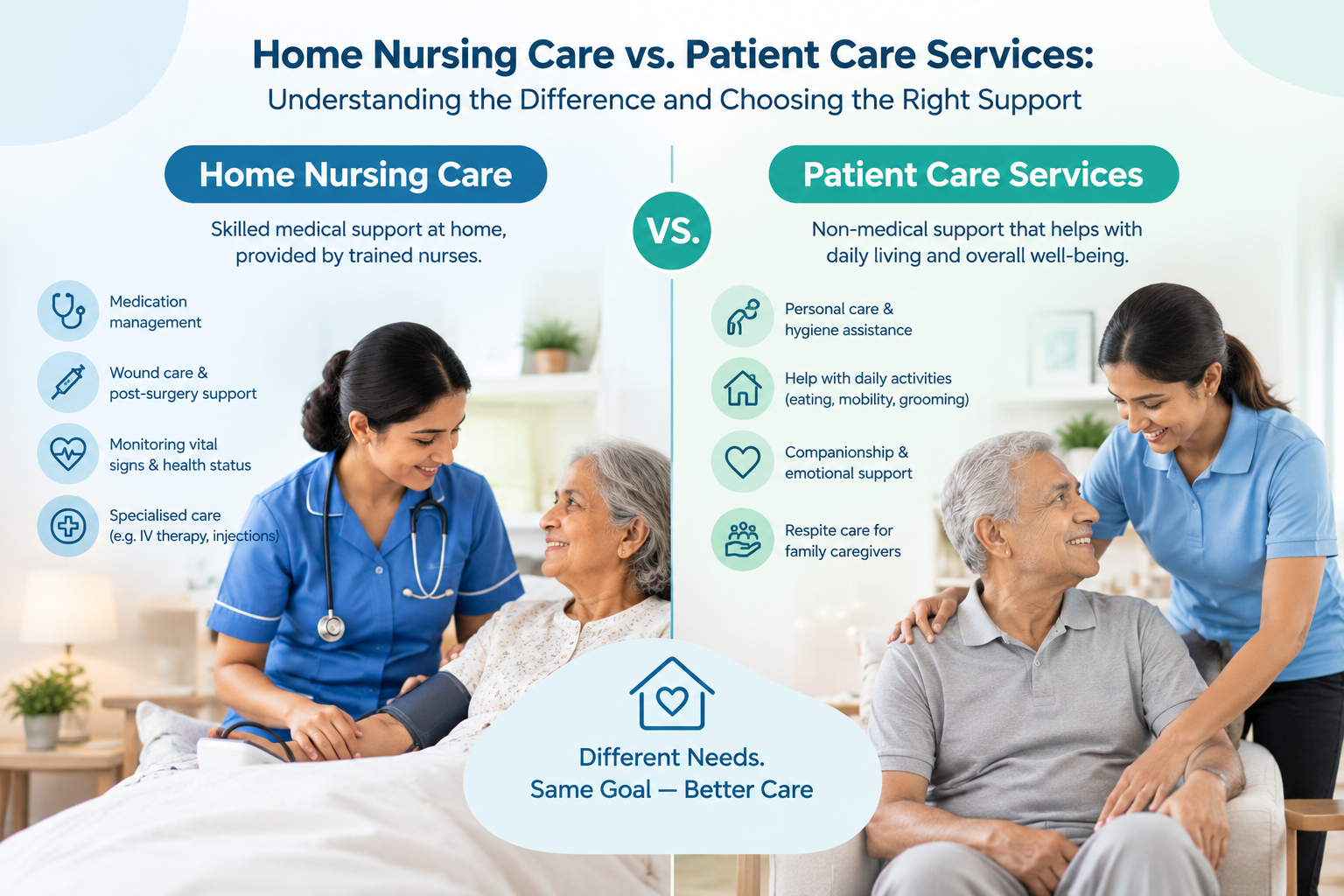
Home nursing care is clinical care given by a qualified nurse at a patient's home, while patient care services provide a trained attendant who helps with daily activities such as bathing, feeding and moving around. Both are common parts of home healthcare, but they are not interchangeable, and choosing the wrong one can leave a patient without the care they actually need.
This guide compares the two side by side: what each person is trained to do, where the line between them falls, and how families can decide which support, or which combination, suits the patient.
What Is Home Nursing Care?
Home nursing care is professional nursing delivered at home by a qualified nurse, following a care plan based on the treating doctor's instructions. It covers work that needs clinical training and the ability to judge whether a patient's condition is changing.
In India, nurses qualify through recognised courses such as the ANM (Auxiliary Nurse Midwife) programme, the GNM (General Nursing and Midwifery) diploma or a B.Sc in Nursing. The Indian Nursing Council sets uniform standards for this training, and a recognised qualification allows a nurse to enrol on a State nursing register.
Ayushya's home nursing care service supports patients through short recoveries and long-term conditions. The company states that its nurses hold ANM, GNM or B.Sc Nursing qualifications and receive home-care training before they are placed with a family.
What Are Patient Care Services?
Patient care services provide a trained attendant, often called a caretaker or patient care assistant, who helps a patient with the everyday activities they can no longer manage alone. The role is supportive and non-clinical.
Families usually turn to an attendant when the patient's medical condition is under control but daily life has become hard: getting out of bed, using the toilet, eating, or simply not being left alone. Through Ayushya's patient care services, attendants work alongside the family and keep them updated on the patient's status. Where care is needed round the clock, two attendants usually share the 24 hours in shifts.
What Is the Difference Between a Nurse and a Patient Attendant?
The core difference is clinical responsibility. A nurse is a trained healthcare professional who can carry out prescribed medical procedures and assess a patient's condition, while an attendant supports daily living and does not perform medical procedures or make clinical decisions.
| Aspect | Home nurse | Patient attendant |
|---|---|---|
| Training | Recognised nursing qualification (ANM, GNM or B.Sc Nursing) | Caregiving training for daily assistance |
| Registration | Enrolled on a State nursing register | No nursing registration |
| Main focus | Clinical care and monitoring | Daily living, comfort and safety |
| Medical procedures | Yes, as prescribed | No |
| Medicines | Gives prescribed medicines, including injections | May help the patient take oral medicines on time, as instructed |
| Changes in condition | Assesses them and informs the doctor | Notices them and tells the nurse, doctor or family |
A useful way to see the line is by risk: tasks that could harm the patient if done wrongly belong with the nurse. If you want to understand the wider split between clinical care and everyday help, our article on medical care vs. daily patient assistance at home explains it from the patient's point of view.
Which Responsibilities Require a Qualified Nurse?
Any task that involves a medical procedure, a prescribed treatment or a judgement about the patient's health should be handled by a qualified nurse or another appropriate healthcare professional. At home, that typically includes:
- giving injections and managing intravenous (IV) lines where prescribed;
- dressing surgical wounds and treating bedsores;
- caring for and changing urinary catheters;
- feeding through a nasogastric (Ryle's) tube or other feeding tube;
- checking temperature, pulse, blood pressure and oxygen levels, and acting on abnormal readings;
- handling medical equipment in a critical-care setup, such as a ventilator or infusion pump.
An attendant should not be asked to take on these tasks, even after watching them done many times. If any of them appear in the patient's care plan, a nurse should be part of it.
What Daily Assistance Can a Patient Attendant Provide?
A patient attendant can provide hands-on help with personal care, mobility, meals and company, which together fill most of a dependent patient's day. Typical duties include:
- bathing, grooming and dressing;
- feeding and making sure the patient drinks enough;
- toileting, diaper changes and keeping the patient clean and dry;
- turning a bedridden patient at regular intervals and helping them sit up;
- supporting the patient while walking and helping prevent falls;
- preparing simple meals and keeping the patient's room tidy;
- keeping the patient company and reporting any change in their condition.
What an attendant does not do matters just as much. They do not give injections, change dressings on surgical wounds, adjust medicines or decide whether a symptom needs a doctor. Those decisions sit with the nurse, the doctor and the family.
When Might a Patient Need Nursing Care?
A patient may need home nursing care when treatment continues after they leave hospital, or when their condition needs regular clinical monitoring. Common situations include:
- recovery after surgery, with stitches or a wound that needs dressing;
- a course of injections or IV medicine prescribed by the doctor;
- going home with a urinary catheter or feeding tube;
- recovery from a serious illness, when vital signs need watching;
- bedsores that need clinical treatment rather than basic skin care.
Nursing care can be a few visits a day or a nurse on 12-hour or 24-hour duty, depending on what the doctor advises.
When Might a Patient Need Daily Patient Assistance?
A patient may need an attendant when their medical condition is stable but they cannot safely manage daily activities on their own. That might be an elderly parent who has become unsteady on their feet, a patient whose clinical recovery is complete but who is still weak, someone who is bedridden and needs turning, feeding and hygiene support, or a person with memory problems who needs supervision through the day.
For older adults whose needs are more about routine, companionship and safety than recovery from a specific illness, elderly care services may be a closer fit than patient care alone.
Can a Patient Require Both Types of Support?
Yes. Many patients need both a nurse and an attendant, especially in the first weeks after a hospital stay.
Consider a 70-year-old recovering from hip surgery. In the early days, a nurse dresses the wound and gives prescribed injections, a physiotherapist works on walking, and an attendant helps with bathing, toileting and getting in and out of bed. As the wound heals, nursing visits may reduce while the attendant continues. Each change should be agreed with the treating doctor.
Families can arrange both kinds of support through Ayushya in either city: home nursing care in Mumbai and patient care services in Mumbai, or home nursing care in Pune and patient care services in Pune.
What Should Families Consider Before Choosing the Right Support?
Before choosing, list the patient's daily tasks, mark the ones that need clinical skill, and confirm the qualifications and supervision of whoever will provide care. A few practical checks help:
- Ask to see the nurse's qualification and State nursing council registration.
- Clarify who the attendant reports to when a medical concern comes up.
- Agree shift timings and how handovers between caregivers will work.
- Ask what happens if a caregiver is unwell or unavailable.
- Request a written cost breakdown, since nursing and attendant care are usually priced differently.
If you are still working out whether home care is the right path at all, start with our overview of what home healthcare involves and when patients need it.
Frequently Asked Questions
Can a patient attendant give injections?
No. Injections are a medical procedure and should be given by a qualified nurse or another appropriate healthcare professional, as prescribed by the doctor.
Can a home nurse also help with bathing and feeding?
Yes. A nurse can help with personal care, but when a patient mainly needs long hours of daily assistance, an attendant is usually more suitable, with the nurse focusing on clinical tasks.
Do I need a 24-hour nurse or a 24-hour attendant?
It depends on the patient's clinical needs. If procedures or monitoring are needed through the day and night, choose a nurse; if the patient is stable and mainly needs help with daily activities, an attendant may be enough. Ask the treating doctor before deciding.
How can I check that a home nurse is qualified?
Ask for their nursing qualification and State nursing council registration. A reliable provider should be willing to share both before care begins.
Can care switch from a nurse to an attendant as the patient recovers?
Yes, with the doctor's agreement. Many patients move from nursing care to daily assistance once clinical tasks such as wound care or injections are complete.
Is patient care the same as elderly care?
No, although they overlap. Patient care supports people who are ill, recovering or bedridden, while elderly care focuses on the routine, safety and companionship of older adults.