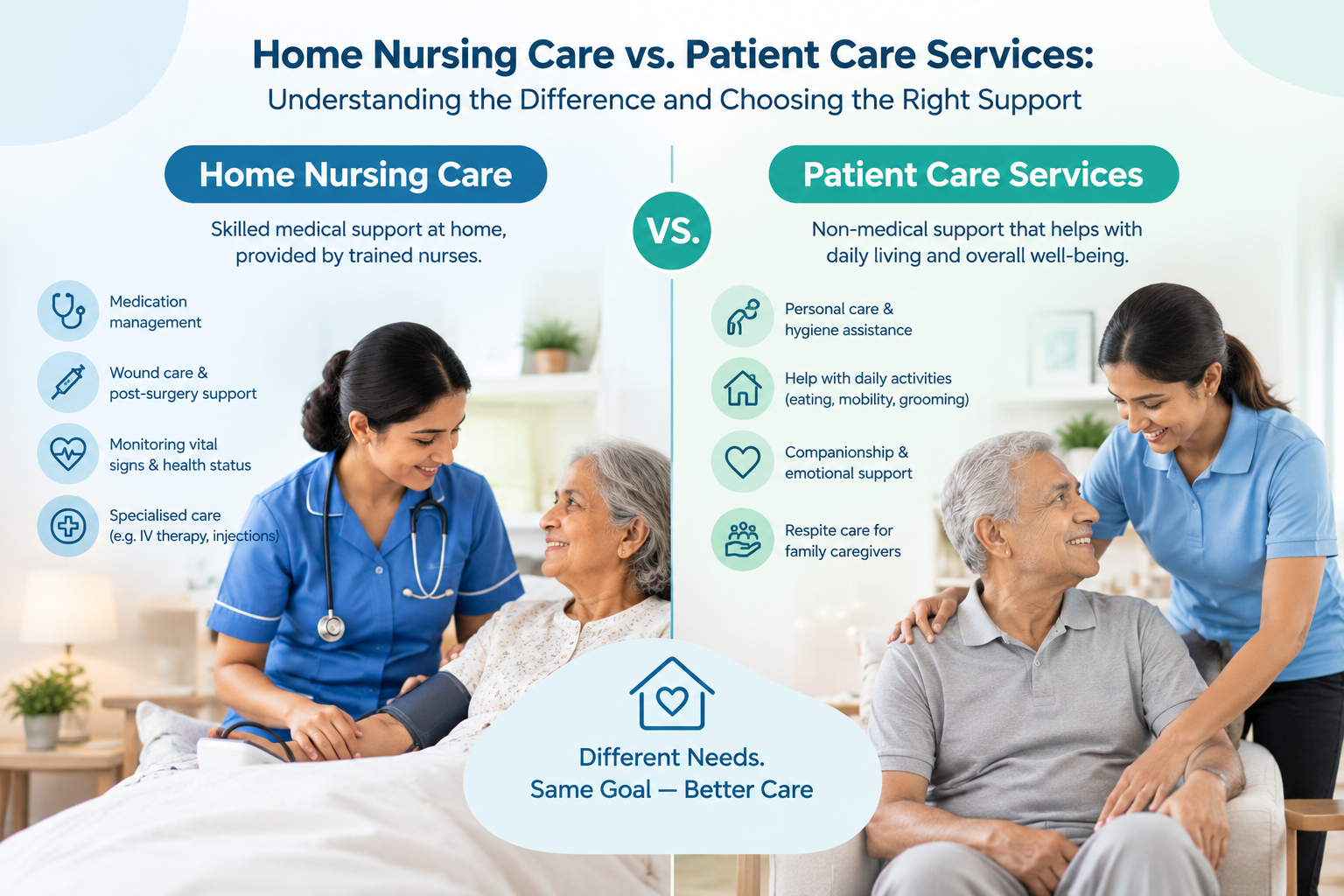

Medical care at home is care that treats, monitors or manages a patient's health condition and needs clinical skill or a doctor's direction. Daily patient assistance is help with the ordinary activities of living, such as bathing, eating, dressing and moving around. Both can be part of home healthcare, but they meet different needs and carry very different levels of risk.
Knowing which is which helps families avoid two common mistakes: relying on general help for tasks that need a professional, and paying for clinical care when a patient mainly needs support with everyday life.
What Is Medical Care at Home?
Medical care at home is any healthcare activity carried out at a patient's residence to diagnose, treat, monitor or rehabilitate a health condition. It is delivered or directed by qualified professionals such as doctors, nurses and physiotherapists.
In practice, home-based medical care may include:
- a doctor examining the patient and reviewing treatment during a doctor visit at home;
- injections at home and other prescribed treatment given by a nurse;
- wound care, catheter care and regular checks of vital signs;
- physiotherapy at home to rebuild strength and movement after surgery or a stroke;
- oxygen or BiPAP therapy used as prescribed, with equipment from a medical equipment rental service;
- critical care through an ICU setup at home for patients whose vitals are stable.
Medical care at home extends hospital treatment rather than replacing it, and its scope should always be set by the treating doctor.
What Does Daily Patient Assistance Mean?
Daily patient assistance is non-medical support with the routine activities a person needs to get through the day, often described as activities of daily living. It keeps a patient clean, fed, comfortable, safe and connected, without directly treating their illness.
It usually works on two levels:
- Personal care: bathing, grooming, dressing, eating, toileting, continence care, moving from bed to chair and walking.
- Household and social support: preparing simple meals, keeping the patient's room clean, accompanying them and giving them company.
This support is generally provided by trained attendants or by family members. Ayushya offers it through patient care services and, for older adults, through elderly care services. The World Health Organization's work on long-term care for older people treats this kind of caregiving and social support as a core part of care, alongside health services.
How Are Medical Care and Daily Assistance Different?
Medical care treats or manages a health condition and needs clinical skill; daily assistance supports a person's everyday life and does not. The difference shows up in purpose, the people involved, who sets the plan and what is at stake if something goes wrong.
| Aspect | Medical care at home | Daily patient assistance |
|---|---|---|
| Purpose | Treat, monitor or rehabilitate a condition | Support everyday living, comfort and safety |
| Set by | The treating doctor's prescription and care plan | The patient's routine and the family's needs |
| Provided by | Doctors, nurses and physiotherapists | Trained attendants, caretakers and family members |
| Examples | Injections, wound dressing, physiotherapy, oxygen therapy | Bathing, feeding, dressing, walking support, company |
| If done wrongly | Can directly harm the patient's health | Can lead to falls, skin problems or poor nutrition |
| Typical duration | Often linked to a phase of treatment | Often ongoing |
Which Activities Require Trained or Qualified Medical Professionals?
Activities that follow a prescription, involve a medical procedure or call for judgement about how the patient's health is changing need a qualified professional.
That covers giving injections, managing IV lines, dressing surgical wounds, handling catheters and feeding tubes, adjusting oxygen therapy, planning exercises after surgery, and deciding whether a change in the patient's condition needs a doctor. These responsibilities belong with doctors, nurses and physiotherapists. How the work divides between a nurse and an attendant in a household is covered in our guide to home nursing care vs. patient care services.
A simple test helps: if a mistake could harm the patient's health directly, or if the task appears on a prescription, treat it as medical care.
What Types of Everyday Support May Patients Need?
The everyday support a patient needs depends on how much independence they have lost and why. Some typical patterns:
- After surgery: help getting in and out of bed, bathing safely and reaching the toilet in the first weeks.
- Bedridden patients: regular turning, hygiene, feeding and keeping the skin clean and dry.
- Older adults living alone: meals, a steady daily routine, reminders to take oral medicines as prescribed, and company.
- People with memory problems: supervision, gentle prompting and a predictable routine.
- After a stroke: help with walking, dressing and eating while strength returns.
These needs change over time, so the level of help is best reviewed every few weeks rather than fixed at the start.
Why Is It Important to Identify a Patient's Actual Care Requirements?
Identifying the real care requirement protects both the patient and the family. Too little clinical care can put the patient at risk, while too much can add cost and disruption without adding benefit.
Consider two situations. In the first, a family relies on an attendant for a patient who has come home on a schedule of injections and wound dressings; the clinical tasks get done late, incorrectly or not at all. In the second, a stable elderly parent who mainly needs help bathing and walking is given round-the-clock nursing, when an attendant with periodic nurse or doctor visits may have met their needs.
Needs also shift. A plan that suited the first week after discharge may be wrong a month later, which is why reviewing it with the treating doctor matters.
Can Medical Care and Daily Assistance Work Together?
Yes. For many patients, the best home care combines both, with professionals handling the medical side while an attendant or family member supports daily life.
Take an older patient recovering from a stroke. A doctor may visit periodically to review treatment, a physiotherapist works on movement a few times a week, and an attendant helps with bathing, meals and walking every day. When the attendant notices the patient seems more confused or weaker than usual, they tell the family, who contacts the doctor.
This works only when everyone knows their role and someone coordinates. A single provider with one care plan makes that easier. Ayushya arranges both medical care and daily assistance in Mumbai and Pune.
How Can Families Decide What Type of Support Is Appropriate?
Families can decide by listing the patient's needs, sorting them into medical and daily categories, and confirming the plan with the treating doctor.
- Write down everything the patient needs help with over 24 hours.
- Mark each item that involves a prescription, a procedure or health monitoring as medical care.
- Mark everything else as daily assistance.
- Note how many hours each category needs and at what times of day.
- Share the list with the treating doctor and ask what can safely be managed at home.
- Arrange qualified professionals for the medical items and an attendant or family member for the rest.
Families should also know when a patient on daily assistance needs a medical review: fever, new breathlessness, increased confusion, a fall, a wound that looks red or swollen, or eating and drinking much less than usual. Emergencies such as chest pain, severe breathlessness, sudden weakness or loss of consciousness need immediate help, so call 112 or 108 for an ambulance.
Contact Ayushya Healthcare Services
Frequently Asked Questions
Is daily patient assistance a medical service?
No. Daily patient assistance is non-medical support with activities such as bathing, eating and moving around; it does not include treatment or medical procedures.
Can daily patient assistance replace nursing or medical care?
No. An attendant supports daily life but cannot replace a nurse, a doctor or medical supervision when the patient has clinical needs.
Does medical care at home always need a doctor's prescription?
In most cases, yes. Injections, medicines, oxygen therapy and many nursing procedures should follow a doctor's prescription or care plan, and physiotherapy should follow a proper assessment.
Is physiotherapy at home considered medical care?
Yes. Physiotherapy is a clinical rehabilitation service delivered by a qualified physiotherapist according to a plan suited to the patient's condition.
Can family members provide daily assistance at home?
Yes. Family members often handle daily assistance, and they can learn some tasks under a doctor's or nurse's guidance, but they should not attempt clinical procedures without proper training.
How do I know when a patient needs more than daily assistance?
When their condition changes or a new clinical task appears. Fever, breathlessness, confusion, falls, wounds that are not healing, or a new prescription for injections are signs to involve a doctor or nurse.